Stop spending your life almost doing the things that matter most.
Can I make a bit of an assumption?
I'm guessing you already know what you want.
Maybe it's starting the business. Maybe it's growing it. Maybe it's finally having that conversation you've been putting off, putting yourself forward for something exciting, setting a boundary or doing the thing you've been saying you'll do for months.
The problem isn't knowing what you want. It's what happens after you've decided you want it.
You tell yourself you're going to do it and, before long, the questions start. What if it goes wrong? What will other people think? What if you're not quite ready yet?
It all sounds very sensible in the moment, doesn't it? Which is probably why we listen. If it sounded ridiculous, we'd ignore it.
Until one day you look back and realise you've spent far too much of your life almost doing the things that matter most.
Not because you weren't capable. And certainly not because you didn't care enough. It's because fear quietly kept getting the final vote.
And if you've just spent the last five days doing Doubt The Doubt with me, you've probably started to see that happening in real time.
You've noticed the voice and caught some of the perfectly reasonable-sounding things it says. And, hopefully, you've also had moments where you didn't automatically do what it told you to do.
So you don't have to take my word for it anymore. You've started experiencing what can happen when fear gets to have an opinion without automatically getting the deciding vote.
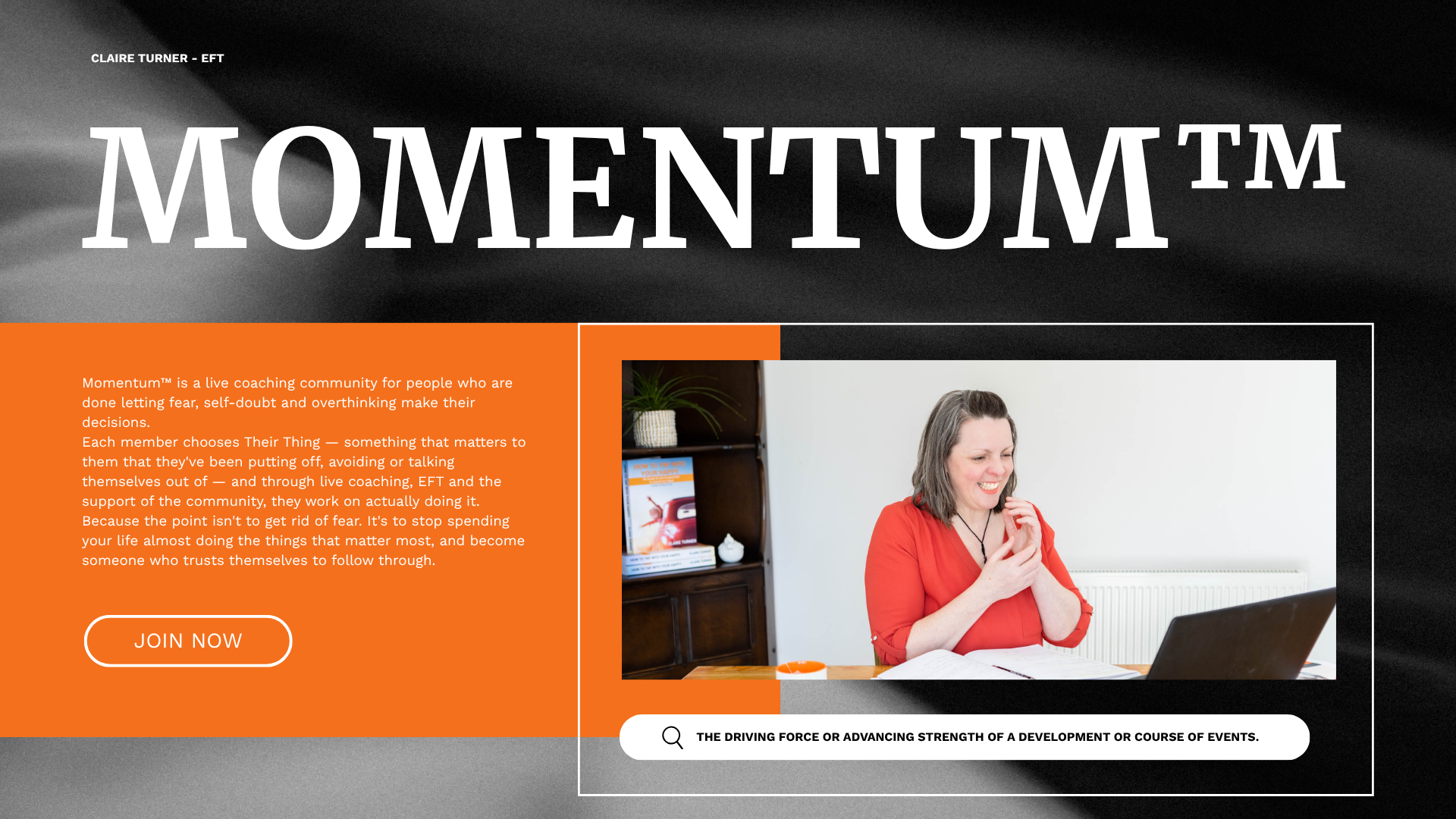
Momentum™ is for the moment you decide you're no longer willing to let that happen.
It's where we take what you've started this week and turn it into something you can actually live. Not by trying to get rid of fear altogether — good luck with that — but by getting better at hearing it without continually handing it the final decision.
You probably don't need anybody else telling you what you should be doing. That's half the frustration. What you need is somewhere to work with whatever keeps getting between knowing and actually doing it, so you can start following through on the things that matter to you.
And once you understand why fear can sound so bloody convincing in the first place, the fact that you've been listening to it starts making a lot more sense too.
Can I tell you what I think is really going on?
I don't actually think most people wake up one morning and decide they're going to spend years holding themselves back.
Nobody sits there thinking, "I'd quite like to spend the next five years overthinking everything and talking myself out of opportunities."
It happens much more quietly than that.
You decide you're going to do something that matters to you and, before long, a little voice chips in with what sounds like a perfectly sensible suggestion.
"Maybe just leave it for another day or two."
Or perhaps you decide you need a bit more information first. So you do another course, listen to another podcast or spend another evening trying to work out the "best" way to do it.
The frustrating thing is, none of those ideas sound ridiculous. They sound sensible.
That's why so many intelligent people end up stuck for years.
You're not necessarily choosing to hold yourself back. You're responding to something that, in the moment, genuinely feels like a good reason to wait.
Your brain does want you to achieve your goals. Of course it does. But it also has another job and, if those two jobs ever come into conflict, it already knows which one it's going to prioritise:
Keeping you safe.
The interesting thing is, your brain has never actually seen the future.
So when it's trying to work out what might happen next, it has to make a prediction. And the only place it can get the information to make that prediction is from your past.
It looks at experiences from the past and asks, "Have we seen something like this before?" If the answer is yes, it assumes this situation might end the same way.
That's brilliant if the last time you touched a hot pan you burnt your hand.
It's less helpful when you're thinking about asking for more money, putting yourself out there or finally having the conversation you've been rehearsing in your head for weeks.
It has no way of knowing how those things will turn out. All it has is what happened when something felt similar before, so criticism, rejection or being made to feel not good enough can all get thrown into the prediction it's making now.
Before you know it, your brain has reached a conclusion and quietly offers you a suggestion.
"Maybe not today."
The problem is, because that suggestion is based on something real that happened in your past, it feels true.
But a prediction isn't the same thing as a certainty.
And that's where we get caught. We don't experience it as, "My brain has just made a prediction based on something that happened years ago." We experience it as, "I shouldn't do this." The feeling is real, but that doesn't make the prediction true.
And if those predictions came from experience, that gives us something very useful to work with.
The useful thing to know is that your brain can change its mind.
Those predictions aren't set in stone.
Your brain made them from the experiences it had available at the time, which means it can also update them when you start giving it different experiences.
You can probably think of something in your own life that once felt horribly uncomfortable and that you barely think twice about now. At some point your brain had very little evidence that you could handle it. Now it has loads.
Which is why I don't think confidence is something you need to find before you act. In my experience, it tends to show up afterwards, once you've done the thing a few times and your brain has started to realise, "Oh. Apparently we can do this."
That doesn't mean you have to bulldoze your way through fear or force yourself into things you're not ready for. I'm not interested in turning life into one enormous exposure exercise.
But I am interested in what happens when you stop automatically treating discomfort as a stop sign.
Because every time you do something your brain was convinced you couldn't cope with, you give it something new to work with.
And it doesn't even have to go well. Maybe you have the conversation and it doesn't go brilliantly, but you realise you can handle that too. Your brain isn't only learning, "This went well." It's also learning, "I dealt with it."
And I think that's where self-trust really starts to come from.
Not from reaching the point where you never feel afraid again, but from having enough experiences of hearing the fear, doing what matters anyway and discovering that you can deal with what happens next.
Eventually, the question starts to change.
Instead of "What if this goes wrong?" it becomes something much more useful:
"What if I can handle it if it does?"
And you've already started giving your brain some of that new information during Doubt The Doubt. The question is what happens when you keep doing it once the challenge is over.
This is where most people get caught out.
They have a breakthrough, feel different for a few days and assume that means the work is done.
Sometimes it does make a huge difference straight away. But more often, the real change comes from what happens next.
One different experience can show you something is possible. But it's what happens when you keep having those experiences that starts to make the bigger difference.
And this was the bit I kept noticing in my work. People weren't short of insights or breakthroughs. What was harder was turning those moments into the way they actually lived, especially once normal life got involved again.
Which is particularly relevant after a week like Doubt The Doubt. You can have a huge realisation this week and feel completely different about something today. But then normal life gets involved again. Something knocks your confidence, a bigger opportunity appears or that very sensible voice finds a new reason why this time you really should wait.
Because there's always something else. You solve one problem and then a bigger opportunity appears. You finally put yourself out there and now you have to keep doing it. You have the difficult conversation and realise there are other places you've been keeping quiet too.
That's not going backwards. That's progress. The more your life moves, the more there is to move towards.
This is exactly why I created Momentum™
I wanted somewhere you could take what you've started in Doubt The Doubt and keep putting it into practice when real life starts handing you new reasons to overthink, hesitate or wait.
Not another course or a pile of information to work your way through. Somewhere built around whatever actually matters in your life right now.
Momentum is about taking what you already know and actually doing something with it.
And at the centre of it is something we call Your Thing.
Your Thing is simply the thing that matters most to you right now. The thing you've been circling, delaying or quietly promising yourself you'll get round to.
For one person it'll be starting the business. For someone else it'll be asking for a promotion, putting themselves out there, setting a boundary, raising their prices or finally making a decision they've been putting off for far too long.
The actual Thing will be different for everyone, which is exactly the point. You're not joining so I can tell you what your next goal should be. You're joining because there's already something you want, and you're tired of being the reason it keeps not happening.
And I think it's worth asking what actually changes if you do it, because Your Thing is rarely just about getting one more thing ticked off a list. If you finally start the business, that business can now grow, make money and give you choices you didn't have while it was still an idea. If you ask for the promotion, your income and career can change. If you set the boundary, you may get time, energy or peace back that you've been giving away for years. If you have the conversation, a relationship that has been stuck can finally move somewhere.
That's the real point of Your Thing. There's something on the other side of it that you want.
Everything inside Momentum is there to help you keep moving towards that. You bring whatever is getting in the way now, we work with it, and then you take the next step in real life. Sometimes that next step will feel huge and sometimes you'll wonder why you made such a song and dance about it in the first place. Either way, you're moving.
And while you're doing that, you're also giving your brain the repeated evidence we talked about earlier. Not another promise that this time you'll follow through, but actual experience of doing it.
I've seen what that can change. One client, Michael, had been avoiding chasing overdue invoices because of what he thought asking for payment said about him. Once we worked through that, he collected the money he was owed, started taking specific action to bring in more clients and increased his weekly income from £480 to £1,400.
That's what I mean by things changing outside the coaching room.
Then, when Your Thing is done, there's usually another one. Not because we're endlessly inventing problems to solve, but because you've moved. Your life is in a different place now, so something else becomes possible.
That's where the name Momentum comes from.
You might join because there's one thing you're absolutely sick of talking yourself out of. But my bigger goal is that, over time, you become someone who doesn't keep leaving the things they want sitting in the category of "almost".
And you get to see what becomes possible when you actually start doing them.
So, how does Momentum™ actually work?
I've kept Momentum deliberately simple because the last thing I want to give you is more stuff to keep up with.
There isn't a huge content library waiting for you, and you're not going to join and immediately find yourself three weeks behind because everyone else has apparently watched seventeen modules you haven't even opened.
This is about what's happening in your life now.
As I mentioned, the first thing we'll do is book your private Momentum Kickstart. You won't join and then sit around waiting for the first group call to get started. We'll work out Your Thing, what's been getting in the way and what your first move is going to be. So from the beginning, there's something real happening in your actual life, rather than a vague intention to "work on yourself".
From there, we have two live group coaching and EFT sessions each month. There isn't a set topic or curriculum because I don't know what your brain is going to decide is terrifying three Tuesdays from now.
You bring what's actually going on.
Maybe you've got as far as writing the email but can't press send. Maybe an opportunity has come up and you've already produced fourteen very convincing reasons why now isn't the right time. Or perhaps you've been moving really well and then suddenly hit something you weren't expecting.
That's what we'll work with.
We'll look at what's actually underneath the resistance, use coaching and EFT where it's useful, and get you back to a place where you can take the action rather than automatically letting fear make it for you.
Then, once a month, we have a Follow Through session.
This one is deliberately a bit different. It's less about going deep and more about looking at what's actually happened since we last spoke. What's moved? What hasn't? What have you done that you nearly didn't do? Where have you quietly disappeared down a side quest and convinced yourself it was terribly important?
We'll celebrate what you've done, sort out anything that's getting in the way and make sure you leave knowing what your next move is.
And between calls, there's the private Momentum™ WhatsApp group.
I wanted that because resistance rarely has the decency to appear ten minutes before a scheduled coaching call. It tends to show up when you're sitting at your laptop about to press publish, or just after someone's said something that's knocked you sideways.
The group gives you somewhere to bring those moments while they're actually happening, ask for help when you need it and share the wins as they happen too.
You shouldn't need to become a full-time student of yourself in order to change your life. The point isn't how much work you do inside Momentum. It's whether your life outside it starts looking different.
What could actually change if you stopped talking yourself out of things?
Quite a lot, when you think about it.
Because we're not really talking about whether you become a bit more confident or stop overthinking quite so much. Those things are lovely, but I'm far more interested in what you get to do because you're no longer spending so much time stuck in your own head.
You make the decision instead of thinking about it for another three weeks, which means things start moving faster. You send the email, make the offer, apply for the opportunity, start the business, ask for more money or have the conversation instead of repeatedly moving it onto tomorrow's to-do list.
And, of course, those things have consequences.
The offer that's currently making you precisely £0 while it sits in your notebook actually gets launched. You put yourself forward for the opportunity instead of ruling yourself out before anyone else gets the chance. You ask for the money you're owed, say the thing that needs saying or make the decision you've been circling for months.
And because you're actually doing those things, you finally get to find out where they might lead.
There's a quieter result too, and I don't think it's insignificant.
You get a lot of your brain back.
All those hours spent analysing, rehearsing, second-guessing, Googling, asking three different people what they think and then ignoring all of them because you're still not sure...you get to use that time and energy for something else.
And I think that's the bigger point. The things you've been talking yourself out of aren't happening in isolation. Doing them can change what happens next. You launch the offer and now you've got something you can actually grow. You have the conversation and the relationship has somewhere to go. You set the boundary and get back time or energy you've been giving away. You take the opportunity and find out where it leads.
None of that was available while you were still thinking about doing it.
Who is Momentum™ for?
Momentum is for you if you're reading all of this thinking, "I know. That's the frustrating part. I KNOW."
You probably don't need me to tell you what you should be doing. In fact, there's a good chance you could give someone else excellent advice about the exact thing you're struggling with yourself.
You're self-aware. You've probably done a fair bit of work on yourself already. You understand your patterns, you know when you're overthinking and, quite often, you can even hear yourself coming up with the excuse while you're doing it.
And yet knowing that doesn't always stop it.
You still find yourself putting things off that matter to you, making something far more complicated than it needs to be or waiting for a level of certainty that, if we're honest, probably isn't coming.
Momentum is for the person who's reached the point where another insight probably isn't the thing that's going to change anything. Doing something differently is.
You know you can do more than you're currently doing. And you're getting increasingly pissed off with watching yourself be the reason some of it still isn't happening.
You don't have to be ambitious in the conventional sense, and Your Thing doesn't have to be about building a business, earning more money or achieving something impressive.
It just needs to matter to you.
You might want more from your business or career, but you might equally want to leave something that's making you miserable, start dating again, have a conversation you've been avoiding, write the book that's been sitting in your head for ten years or finally stop saying yes when every part of you wants to say no.
I don't particularly care whether anyone else thinks Your Thing is a big deal. If you've been talking yourself out of it and your life would be better because you finally did it, that's enough.
What does matter is that you're willing to do something.
Momentum isn't somewhere to endlessly analyse why you are the way you are while nothing changes outside the Zoom room. We'll absolutely look at what's getting in the way, and sometimes we'll go pretty deep with it, but we're doing that because there's somewhere you want to go.
So if Doubt The Doubt has made you realise that you don't actually need to get rid of every fear, doubt or uncomfortable feeling before you move, and you're ready to find out what happens when you stop giving those things quite so much authority over what you do, you'll fit in very nicely here.